
Understanding royalty free vs extended license is essential if you want to sell icon sets professionally. Many designers focus on creating great visuals, yet licensing often determines how much you actually earn. Therefore, knowing the difference helps you protect your work and increase revenue.
At first, licensing may feel confusing. However, once you understand the structure, it becomes a powerful tool. In fact, designers who master royalty free vs extended license models often build more scalable income streams.
In this guide, you will learn how licensing works, how to choose the right model, and how to align your pricing with real usage. More importantly, you will discover how to avoid common mistakes that limit your earnings.
Why Licensing Matters More Than Pricing Alone
Pricing attracts buyers, but licensing defines value. When you sell icon sets, you are not just selling files. Instead, you are selling usage rights.
Because of this, royalty free vs extended license options directly affect how your products are perceived. A simple license may attract more buyers. However, a more flexible license can justify higher pricing.
Moreover, licensing protects your work. Without clear terms, buyers may misuse your designs. As a result, you could lose potential income.
Therefore, understanding royalty free vs extended license is not optional. It is a key part of building a sustainable design business.
What Royalty Free License Really Means
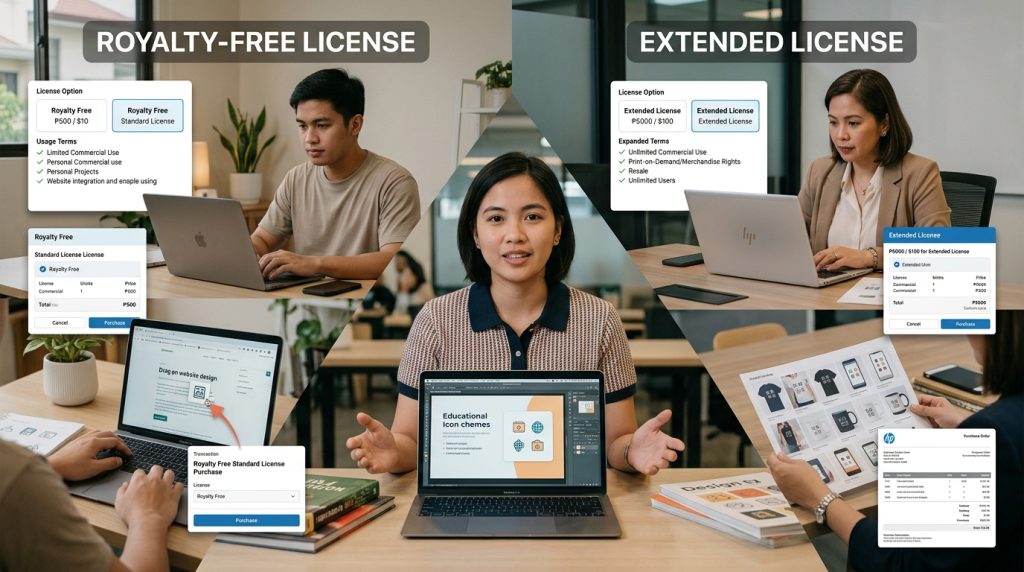
A royalty-free license allows buyers to use your icons without paying ongoing fees. Once purchased, they can use the assets within specific limits.
For example, a standard license often allows:
- Use in personal or commercial projects
- Limited distribution
- No resale as standalone assets
Although the name suggests “free,” it does not mean zero cost. Instead, it means buyers pay once and use the asset repeatedly.
Because of this, royalty free vs extended license comparisons often start here. Royalty-free licenses are simpler and easier to sell.
However, they also limit how much you can charge. Since usage rights are restricted, pricing must stay competitive.
Understanding Extended Licenses For Commercial Use
Extended licenses offer broader usage rights. These licenses are designed for businesses that need more flexibility.
For instance, an extended license may allow:
- Use in large-scale commercial projects
- Unlimited distribution
- Use in products for resale
Because of these benefits, extended licenses command higher prices. Buyers pay more because they gain more freedom.
When comparing royalty free vs extended license, this is the biggest difference. Extended licenses unlock higher earning potential.
However, they also require clear definitions. Without proper terms, confusion can arise.
Choosing The Right License For Your Icon Sets
Choosing between license types depends on your goals. If you want volume sales, a basic license may work best. On the other hand, if you want higher margins, extended licenses are more effective.
When applying royalty free vs extended license strategies, consider your audience. Small businesses may prefer affordable options. Meanwhile, agencies often need extended rights.
Additionally, offering both options can increase flexibility. Buyers can choose based on their needs.
This approach works well on marketplaces like https://www.creativemarket.com or https://graphicriver.net, where multiple license tiers are common.
How Licensing Impacts Your Pricing Strategy
Licensing and pricing go hand in hand. You cannot separate them if you want consistent results.
When using royalty free vs extended license models, pricing should reflect value. A standard license should be affordable. Meanwhile, extended licenses should carry a premium.
For example, you might price:
- Standard license at a lower entry point
- Extended license at a significantly higher tier
Because of this structure, you capture both budget buyers and high-value clients.
Moreover, this strategy supports long-term growth. You build volume while still maximizing revenue.
Common Mistakes Designers Make With Licensing
Many designers underestimate licensing. As a result, they leave money on the table.
One common mistake is offering only one license type. This limits your earning potential. Another mistake is setting unclear terms, which creates confusion for buyers.
Additionally, some designers price extended licenses too low. This reduces perceived value.
When managing royalty free vs extended license options, clarity is critical. Buyers should immediately understand what they are getting.
To improve your structure, you can organize your licensing content similarly to resource hubs like https://www.wellnessonthegreen.com/golf-buying-guides.
How To Communicate Licensing Clearly
Clear communication builds trust. If buyers do not understand your licensing, they may hesitate to purchase.
When explaining royalty free vs extended license, keep it simple. Use plain language instead of legal jargon.
For example:
- Clearly define allowed uses
- Highlight key differences between license types
- Provide examples of use cases
Because of this, buyers feel more confident. As a result, conversions improve.
Additionally, visual comparisons can help. Simple charts or bullet points make information easier to digest.
Scaling Your Business With Better Licensing
Licensing is not just about protection. It is also about scalability.
When you use royalty free vs extended license effectively, you create multiple revenue streams from the same product. A single icon set can generate income from different types of buyers.
For instance, freelancers may buy standard licenses. Meanwhile, companies may purchase extended licenses.
Because of this, your income potential increases without creating new products.
Moreover, licensing allows you to grow without increasing workload. This makes it one of the most powerful tools for designers.
Where To Sell And Apply Licensing Models
Different platforms support different licensing structures. Therefore, choosing the right platform matters.
Popular marketplaces include:
- Creative Market: https://www.creativemarket.com
- Envato Elements: https://elements.envato.com
- Adobe Stock: https://stock.adobe.com
Each platform has its own rules. However, most support royalty free vs extended license options in some form.
Additionally, selling through your own website gives you more control. You can define your own terms and pricing.
For example, structuring your content and products like https://www.wellnessonthegreen.com/golf-insights-and-tips can help organize your offerings.
Balancing Simplicity And Flexibility
While licensing is important, it should not overwhelm buyers. Too many options can reduce conversions.
When working with royalty free vs extended license, aim for balance. Offer enough flexibility without creating confusion.
For instance, two or three license tiers are often enough. This keeps choices simple while covering different needs.
Because of this, buyers can decide quickly. At the same time, you maintain pricing flexibility.
Conclusion
Understanding royalty free vs extended license is one of the most important steps for icon designers who want to grow their business. While design quality attracts attention, licensing determines how your work is used and valued.
By offering both standard and extended options, you can serve a wider audience. Moreover, clear communication ensures buyers understand exactly what they are purchasing.
As you refine your licensing strategy, you will notice improved conversions and higher revenue potential. Over time, this approach allows you to scale your business without increasing workload.
Ultimately, mastering royalty free vs extended license models gives you control. Instead of guessing, you make strategic decisions that support long-term success.
FAQ
- What is the difference between standard and extended licenses?
A standard license has limited usage, while extended licenses allow broader commercial use. - Should beginners offer multiple license options?
Yes, offering basic and extended options helps reach different types of buyers. - Can I change my licensing later?
Yes, but it is better to define clear terms early to avoid confusion. - Why do extended licenses cost more?
They allow broader usage, which increases their value for businesses. - Do all marketplaces support different license types?
Most major platforms offer multiple licensing options, but the terms vary.