
The design industry evolves quickly. Therefore, professionals must continuously adapt to new platforms and workflows. Design communities tools help creatives stay informed, connected, and competitive in a fast-changing environment.
When designers actively engage with design communities tools, they gain early access to trends, updates, and best practices. Moreover, these communities offer real-world insights that official product announcements often miss. As a result, designers improve their skills while avoiding outdated methods.
This article explores how collaborative networks and shared platforms help professionals stay ahead of evolving software and workflow innovations.
Why Staying Updated Matters More Than Ever
Creative software changes rapidly. New features appear frequently. Interfaces shift. Automation increases. Consequently, designers who ignore updates risk falling behind.
Modern projects demand efficiency and technical awareness. Clients expect familiarity with the latest platforms. Additionally, companies prefer designers who adapt quickly.
Design communities tools reduce the learning curve. Instead of researching alone, designers access peer knowledge. Community members share shortcuts, plugin recommendations, and workflow improvements.
Furthermore, group discussions reveal emerging industry patterns. Designers recognize which platforms gain traction and which tools lose relevance.
By staying informed through active networks, professionals remain agile and prepared for change.
Peer Learning Accelerates Skill Development
Formal tutorials help. However, peer-driven learning often moves faster.
Design communities tools allow designers to ask questions directly. Experienced members respond with practical solutions. Consequently, knowledge spreads quickly.
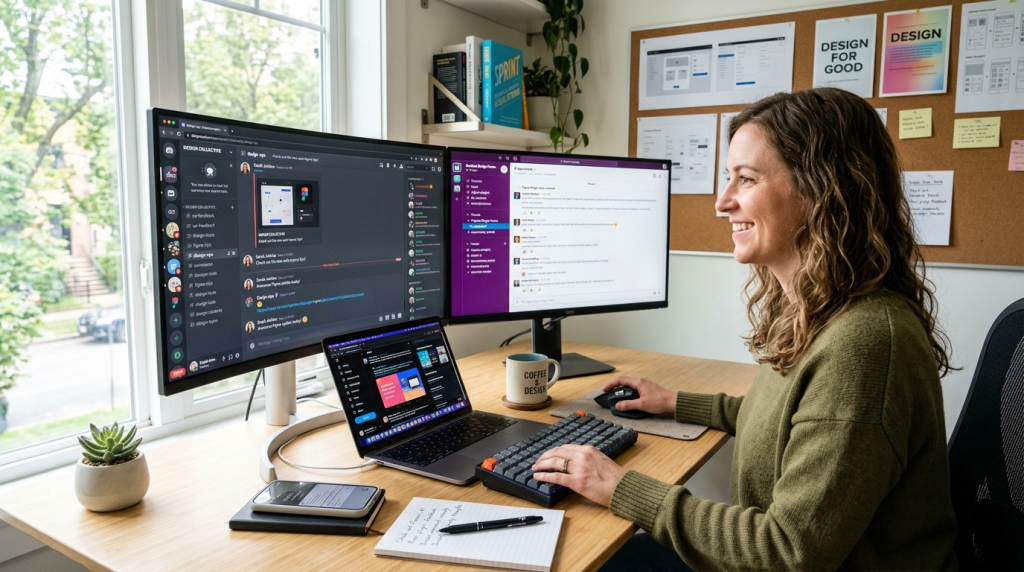
Forums, chat groups, and discussion boards provide real-time problem solving. Designers troubleshoot bugs, explore new features, and test experimental updates together.
Additionally, community challenges encourage hands-on learning. Participants apply new techniques while receiving constructive feedback.
Learning in isolation limits perspective. In contrast, collaborative environments expose designers to diverse approaches.
Through shared expertise, creative professionals build confidence and technical depth more efficiently.
Early Access to Emerging Trends
Trends often surface within communities before mainstream adoption. Therefore, designers who participate actively gain an advantage.
Design communities tools highlight beta releases, plugin experiments, and AI integrations. Members share previews and feedback.
Because contributors test new features early, they identify strengths and weaknesses quickly. This insight supports informed decisions about adoption.
Moreover, trend discussions provide context. Designers understand why certain tools gain popularity.
Without community engagement, professionals may discover innovations too late. However, collaborative networks offer immediate exposure to industry shifts.
Early awareness strengthens career positioning.
Real-World Workflow Insights
Official documentation explains features. Yet, real-world application requires deeper understanding.
Design communities tools offer case studies and workflow breakdowns. Members share how they integrate tools into projects.
For example, designers discuss automation scripts that streamline repetitive tasks. Others demonstrate cross-platform integration methods.
These insights save time. Instead of experimenting blindly, professionals learn from others’ experiences.
Additionally, community examples reveal limitations. Designers avoid common mistakes.
By studying real-world scenarios, creatives refine processes efficiently and strategically.
Networking and Career Opportunities
Communities foster more than technical growth. They also create professional connections.
Design communities tools connect freelancers, in-house designers, and agency teams globally. Members share job openings and collaboration requests.
Moreover, visibility within active networks strengthens reputation. Designers who contribute insights gain recognition.
Networking leads to mentorship opportunities as well. Experienced professionals guide newcomers.
Career growth often depends on relationships. Engaging in collaborative platforms expands opportunities beyond technical skill development.
Active participation strengthens both knowledge and professional presence.
Collaborative Feedback on Tools
Feedback improves software evolution. Designers influence development by sharing experiences.
Design communities tools create spaces for constructive critique. Users report usability issues and suggest enhancements.
Developers monitor these discussions. Consequently, updates reflect real user needs.
Community-driven feedback accelerates product improvement cycles. Instead of isolated reviews, collective insights shape direction.
Moreover, designers learn from others’ feature requests. They discover overlooked functionalities.
Feedback loops benefit both creators and software providers. Open dialogue strengthens tool ecosystems.
Learning Through Shared Resources
Communities curate extensive resources. Templates, UI kits, and plugin lists circulate widely.
Design communities tools often include shared libraries and educational archives. Members upload tutorials and walkthroughs.
This shared knowledge reduces duplication of effort. Designers access ready-made assets instead of rebuilding components.
Additionally, curated collections highlight trusted resources. Professionals avoid low-quality materials.
Because resource sharing enhances efficiency, collaborative platforms remain essential for staying updated.
Exposure to Cross-Disciplinary Perspectives
Design intersects with development, marketing, and research. Therefore, cross-disciplinary interaction improves tool understanding.
Design communities tools often include members from multiple backgrounds. Developers explain technical constraints. Marketers discuss analytics integration.
Exposure to diverse viewpoints broadens understanding. Designers learn how tools support broader product strategies.
This holistic insight strengthens decision-making. Rather than focusing solely on aesthetics, designers consider performance and scalability.
Cross-functional awareness enhances overall effectiveness.
Global Insights and Cultural Awareness
Creative trends vary globally. However, online communities remove geographic limitations.
Design communities tools connect professionals worldwide. Members share region-specific case studies and localized solutions.
Global discussions reveal cultural preferences in UI patterns. Designers adjust approaches accordingly.
Additionally, exposure to international workflows inspires innovation.
Through global collaboration, designers expand creative horizons.
Continuous Motivation and Inspiration
Staying motivated can be challenging. Creative blocks occur frequently.
Design communities tools provide inspiration through showcases and challenges. Members share projects and celebrate milestones.
Seeing others’ progress encourages growth. Furthermore, constructive critique fosters improvement.
Motivation thrives in supportive environments. Collaborative platforms sustain enthusiasm during demanding projects.
Creative energy increases when professionals feel connected.
Adapting to AI and Automation Changes
Artificial intelligence transforms design workflows rapidly. Therefore, staying informed about AI updates is critical.
Design communities tools track automation features and integration strategies. Members share experiments with generative design.
Community discussions clarify ethical considerations as well. Designers explore responsible AI usage collectively.
Without shared dialogue, understanding AI advancements becomes overwhelming. However, collaborative exploration simplifies adaptation.
Active engagement supports confident adoption of automation innovations.
Building a Personal Knowledge System
Community engagement works best when structured. Designers should document insights from discussions.
Design communities tools often allow bookmarking threads and saving resources. Organized notes support long-term retention.
Additionally, revisiting archived discussions reinforces learning.
By combining community interaction with personal documentation, designers create sustainable growth systems.
Consistency ensures knowledge compounds over time.
Strong Conclusion
Design evolves continuously. Consequently, professionals must remain proactive learners.
Design communities tools provide more than updates. They create ecosystems for collaboration, feedback, and growth. Through peer learning, early trend exposure, and global networking, designers stay competitive.
Communities transform isolated work into shared progress. Collective insight accelerates skill development and tool mastery.
Moreover, collaborative platforms strengthen career opportunities and motivation.
Those who engage consistently gain strategic advantages. Meanwhile, those who remain disconnected struggle to adapt.
Ultimately, design communities tools act as catalysts for continuous improvement. By participating actively, designers stay informed, inspired, and prepared for the future of creative technology.
FAQ
- Why are online design groups valuable for professionals?
They provide real-time updates, peer support, and exposure to emerging software trends. - How do communities help with new feature adoption?
Members test updates early and share practical implementation tips. - Can participating in creative forums improve career growth?
Yes. Networking and visibility within communities open collaboration and job opportunities. - What types of resources do design networks share?
Templates, plugin recommendations, tutorials, and workflow breakdowns are common. - How can designers manage information from community discussions?
Saving threads, organizing notes, and revisiting shared resources support long-term learning.