

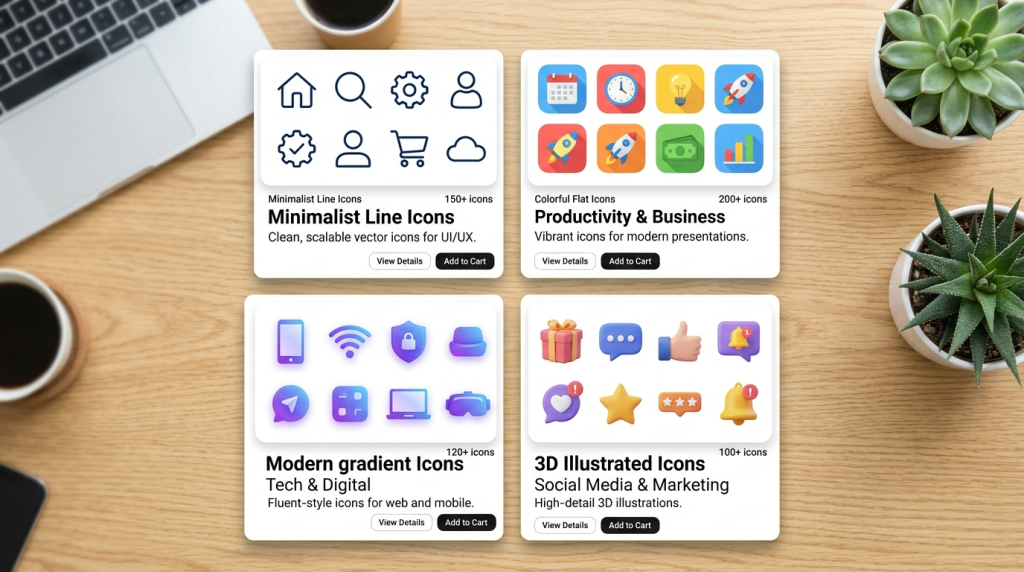
If you want to sell icon sets successfully, you must think beyond design alone. Great visuals matter, but strategy determines income. From licensing models to distribution channels, every decision influences profit and credibility.
Designers often focus only on aesthetics. However, professional sellers approach icons as digital products. They refine packaging, clarify usage rights, and build marketing funnels. As a result, their work scales beyond one-off transactions.
In this guide, you will learn how to license, market, and distribute your collections strategically. More importantly, you will understand how to position your work for long-term revenue instead of short-term sales.
Understanding the Icon Market Landscape
Before you sell icon sets, study the market carefully. Icon libraries already exist on major marketplaces. Therefore, differentiation becomes essential.
First, identify your niche. For example, SaaS dashboards, fintech apps, healthcare platforms, and e-commerce stores all require specific styles. When you narrow your focus, you compete on relevance instead of volume.
Next, analyze pricing tiers. Some designers price small bundles cheaply to attract beginners. Others position large collections as premium assets. Both models work. However, clarity in value positioning matters most.
Additionally, examine trends in UI design. Minimal line icons, bold filled styles, and duotone systems each serve different audiences. When you align with current demand, you increase your visibility naturally.
Create Icon Sets That Are Commercially Viable
Professional creators do not just design attractive visuals. Instead, they build scalable systems. Consistency across stroke width, grid alignment, and spacing builds trust instantly.
Start by defining a style guide. Establish grid size, corner radius, stroke weight, and visual rhythm. Because consistency improves usability, buyers prefer well-structured libraries.
Next, organize icons into meaningful categories. Navigation, communication, analytics, commerce, and settings icons often form core groups. Logical grouping improves discoverability.
Moreover, provide multiple formats. SVG files remain essential for flexibility. However, PNG, AI, and Figma-ready files increase accessibility. The easier your files are to use, the more likely professionals will purchase them.
When you sell icon sets with technical precision, you build authority. Quality becomes your strongest marketing tool.
Licensing: Protecting and Monetizing Your Work
Licensing defines how customers can use your assets. Therefore, clarity protects both you and the buyer. Without clear terms, confusion can damage trust.
To sell icon sets professionally, you must understand common license types. Personal licenses allow limited use. Commercial licenses permit broader application. Extended licenses often include resale or multi-product rights.
Many creators use tiered pricing. For example, startups may purchase a basic commercial license. Larger companies, however, might need extended usage rights.
Additionally, define restrictions clearly. State whether redistribution, modification, or sublicensing is allowed. Transparent policies reduce disputes later.
Consider using marketplaces with built-in licensing frameworks if you prefer simplicity. Alternatively, you can draft custom terms for your website. Either way, clarity strengthens your brand.
Royalty-Free vs Exclusive Licensing
Royalty-free licenses allow unlimited use after purchase. Because of that flexibility, they attract a wide audience.
Exclusive licenses, on the other hand, grant rights to a single buyer. Although rarer in icon design, exclusivity can command higher prices.
Choose a model aligned with your goals. If you want scale, royalty-free works well. If you want premium positioning, exclusive deals may suit you better.
Pricing Strategies That Maximize Revenue
Pricing affects perception. Low pricing may attract beginners, but it can also reduce perceived value. High pricing signals quality, yet it demands strong branding.
When you sell icon sets, consider bundle size. Smaller packs can serve as entry products. Larger collections justify premium rates.
Another approach involves versioning. Offer a free sample pack. Then, upsell the full system. Because buyers test quality first, conversions improve.
Furthermore, consider subscription models. Designers working with SaaS products often need ongoing updates. If you release quarterly expansions, you create recurring revenue.
Market research helps refine your numbers. Study competitors. However, differentiate through value rather than price alone.
Marketing Your Icon Sets Effectively
Even exceptional design fails without visibility. Therefore, marketing deserves equal attention.
Start with a strong landing page. Showcase use cases in real UI mockups. Because context sells better than isolated icons, presentation matters greatly.
Next, optimize your product descriptions. Use clear language that highlights benefits, not just features. Instead of listing file types only, explain how your collection saves time.
Search engine optimization also matters. When you sell icon sets on your own site, target relevant long-tail keywords. Include phrases like “SaaS icon pack” or “minimal UI icons” naturally.
Additionally, leverage design communities. Platforms like Dribbble, Behance, and Product Hunt can amplify reach. When you share process insights, engagement increases.
Email marketing remains powerful. Offer a free sample in exchange for signups. Over time, nurture subscribers with updates and new releases.
Social Proof and Testimonials
Buyers trust other buyers. Therefore, collect testimonials whenever possible. Even small startups can provide meaningful feedback.
Feature logos of clients who use your icons. Display usage examples prominently. Social proof builds credibility quickly.
As you sell icon sets consistently, showcase milestones. Announce download numbers or positive reviews. Momentum attracts attention.
Choosing the Right Sales Channels
Distribution influences reach and control. Marketplaces provide instant exposure. However, they often take commissions.
Selling on your own website offers higher margins. Yet you must generate traffic independently.
A hybrid strategy often works best. Use marketplaces for discovery. Then, direct serious buyers to your branded platform for premium bundles.
Furthermore, consider partnership opportunities. Collaborate with template creators or UI kit developers. Bundling your icons inside larger products expands visibility organically.
When you sell icon sets strategically across channels, you reduce risk and diversify income streams.
Branding and Positioning for Long-Term Growth
Brand identity separates hobbyists from professionals. Therefore, invest in cohesive visuals and messaging.
Create a recognizable brand style. Use consistent typography, color palettes, and tone across platforms. Because recognition builds familiarity, branding supports higher pricing.
Craft a compelling story around your design philosophy. Explain your grid system, inspiration, and usability standards. Buyers appreciate thoughtful creators.
Moreover, maintain quality updates. When you release new versions, inform customers clearly. Regular improvements strengthen loyalty.
If you want to sell icon sets sustainably, treat your work like a product line, not a one-time upload.
Building Authority in the Design Space
Publish educational content related to icon design. Tutorials, case studies, and breakdowns demonstrate expertise.
Speak at design events or webinars if possible. Even small community talks expand credibility.
As authority grows, pricing flexibility increases. Buyers often pay more for trusted creators.
Scaling Your Icon Business
Once sales stabilize, scale strategically. Introduce niche expansions or themed collections. For instance, healthcare, fintech, or crypto icons serve distinct audiences.
Automation also improves efficiency. Use digital delivery systems that handle purchases instantly. This setup reduces administrative work.
Track analytics consistently. Identify which platforms convert best. Then, allocate resources accordingly.
When you sell icon sets repeatedly, data becomes your guide. Numbers reveal trends faster than assumptions.
Legal and Administrative Considerations
Beyond licensing, consider copyright registration in your jurisdiction. While not mandatory everywhere, formal registration can strengthen protection.
Keep financial records organized. Track income, expenses, and marketplace fees carefully. Professional bookkeeping prevents tax surprises later.
Use clear contracts for custom requests. If clients request tailored sets, define scope and rights clearly.
Administrative discipline may feel tedious. However, it protects long-term growth.
Conclusion
To sell icon sets professionally, you must think like both a designer and an entrepreneur. Strong visuals attract buyers. However, licensing clarity, pricing strategy, and marketing execution drive revenue.
By defining your niche, protecting your work legally, and positioning your brand carefully, you build sustainable income. Moreover, consistent updates and authority-building strengthen long-term credibility.
Success does not depend on one viral upload. Instead, it results from strategic planning and professional presentation. If you approach your icon collections as scalable digital products, you create lasting opportunity.
FAQ
- How do I choose the right license for my icon designs?
Start by defining your audience. Offer personal, commercial, and extended options to cover different usage needs. - Should I sell on marketplaces or my own website?
Marketplaces provide exposure quickly. However, your own site gives higher margins and stronger brand control. - How can I price my digital assets competitively?
Research competitors, consider bundle size, and test entry-level offers before scaling prices. - What formats should I include in my icon pack?
SVG is essential. Additionally, provide PNG and editable source files to increase usability. - How do I attract repeat buyers?
Release updates regularly, maintain quality, and communicate consistently through email and community platforms.