
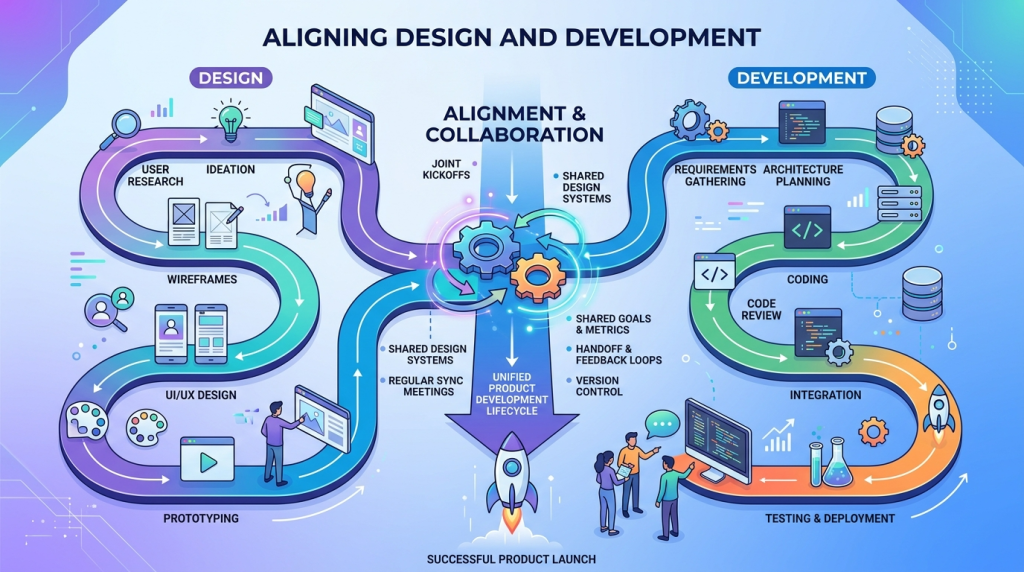
To create successful digital products, teams must align design and development from the very beginning. When these disciplines move in different directions, delays and frustration follow. However, when goals connect clearly, results improve dramatically.
Designers focus on usability, aesthetics, and experience. Developers prioritize performance, scalability, and clean code. Both perspectives matter. Yet without shared objectives, misunderstandings arise quickly.
Therefore, aligning priorities is not optional. It is essential for speed, efficiency, and quality. When you align design and development strategically, you reduce friction and increase product clarity.
Why Misalignment Happens in Digital Teams
Misalignment rarely starts with bad intentions. Instead, it often begins with communication gaps. Designers may present polished mockups without technical input. Meanwhile, developers may interpret requirements differently than intended.
Because timelines are tight, teams sometimes skip collaborative planning. As a result, assumptions replace clarity. Later, revisions multiply and morale drops.
Another common issue involves separate success metrics. Designers may measure visual impact or usability scores. Developers may track performance or deployment speed. Without shared benchmarks, priorities diverge.
To align design and development effectively, you must address these structural gaps early. Clear processes prevent recurring conflict.
Establish Shared Product Goals First
Before discussing wireframes or code, define the product vision together. What problem does the product solve? Who is the target user? What outcome defines success?
When teams answer these questions collaboratively, alignment strengthens naturally. Everyone understands the larger objective.
Next, translate the vision into measurable goals. For example, define performance targets, accessibility standards, and usability benchmarks. Because these goals guide decisions, clarity reduces disagreement.
In addition, document these priorities in a shared workspace. Visibility reinforces accountability. When teams consistently reference the same objectives, collaboration improves.
To align design and development around shared metrics, leadership must encourage open discussion. Transparency builds trust.
Integrate Designers and Developers Early
Many teams treat design and engineering as separate phases. First comes design. Then development follows. Although common, this approach increases risk.
Instead, involve developers during early design exploration. Technical input can shape realistic concepts. Consequently, fewer redesigns occur later.
Similarly, designers should understand system constraints. When they learn about frameworks or performance limitations, they make smarter choices.
Cross-functional workshops help bridge gaps. In these sessions, designers explain user flows. Developers discuss technical feasibility. Together, they refine solutions.
When you align design and development from the ideation stage, innovation improves without sacrificing practicality.
Use Collaborative Tools Effectively
Modern tools simplify teamwork. Shared platforms like Figma, Jira, and Notion centralize communication. Because feedback stays visible, confusion decreases.
Encourage real-time commenting. Developers can flag potential issues directly in design files. Designers can clarify interactions before coding begins.
Version control also matters. Clear documentation prevents outdated mockups from reaching production. As a result, teams avoid unnecessary rework.
Technology alone does not guarantee harmony. However, when used intentionally, it supports smoother collaboration.
Create Clear Handoff Processes
Even with strong collaboration, handoff moments require precision. Ambiguity at this stage often causes delays.
Define what a “ready for development” design includes. Should files contain interaction states, responsive variations, and asset exports? Clarify expectations upfront.
Similarly, define development milestones. What qualifies as feature complete? When should designers review staging builds? Clear checkpoints prevent surprises.
To align design and development during handoffs, use structured documentation. Include component libraries, spacing rules, and style tokens. Because specifications reduce guesswork, implementation improves.
Regular check-ins during development maintain alignment. Quick feedback loops resolve issues before they escalate.
Align Around Design Systems
Design systems provide a shared language. They define components, spacing, typography, and interaction patterns. Because both teams rely on the same foundation, consistency improves.
When you align design and development through a system, efficiency increases. Designers reuse patterns confidently. Developers implement reusable components.
Moreover, updates become easier. Instead of redesigning from scratch, teams refine existing modules.
Investing in a robust design system reduces friction long term. Although initial setup takes effort, scalability improves significantly.
Maintain System Documentation
A design system fails without documentation. Therefore, keep usage guidelines clear and accessible.
Explain when to use certain components. Include code snippets and visual examples. Because clarity supports adoption, teams follow standards more consistently.
Review the system regularly. As products evolve, patterns may require refinement. Continuous improvement strengthens collaboration.
Encourage Open Communication Culture
Tools and processes matter. However, culture matters more. If team members hesitate to raise concerns, misalignment grows silently.
Create an environment where questions feel welcome. Designers should feel comfortable asking about technical limits. Developers should ask about user intent without fear.
Regular retrospectives support improvement. After each sprint, discuss what worked and what did not. Because reflection encourages learning, alignment strengthens over time.
To align design and development sustainably, leadership must model respectful dialogue. Open communication reduces defensiveness and builds trust.
Balance Creativity and Feasibility
Creative ambition drives innovation. Yet feasibility determines delivery. Successful teams balance both forces.
When designers propose bold ideas, developers evaluate implementation paths. Instead of rejecting concepts immediately, they explore alternatives.
Likewise, developers may suggest performance improvements that influence interface design. Collaboration creates better solutions than isolated decision-making.
By working together, teams refine ideas instead of discarding them. Therefore, creative integrity remains intact while technical stability improves.
Measure Outcomes Together
Alignment does not end after launch. Post-release analysis matters equally.
Track user engagement, load times, and feature adoption collaboratively. Because shared data reveals product impact, teams adjust priorities together.
If usability metrics decline, designers can refine flows. If performance drops, developers can optimize code. Continuous feedback strengthens teamwork.
To align design and development long term, evaluate success through shared dashboards. Transparency ensures collective responsibility.
Celebrate Shared Wins
Recognition reinforces collaboration. When a product milestone succeeds, acknowledge contributions from both disciplines.
Celebrating achievements builds morale. Additionally, it reinforces the value of teamwork. When teams see tangible results, motivation increases.
Positive reinforcement strengthens alignment habits naturally.
Overcoming Common Collaboration Challenges
Even with strong systems, challenges arise. Tight deadlines may create tension. Scope changes can disrupt plans.
When pressure increases, communication becomes even more critical. Instead of assigning blame, focus on solutions.
Break large tasks into manageable increments. Because smaller deliverables feel achievable, stress decreases.
Furthermore, clarify priorities when scope expands. Decide collectively which features matter most. Structured decision-making prevents burnout.
To align design and development during difficult phases, maintain empathy. Understanding each other’s pressures builds mutual respect.
Scaling Alignment in Growing Organizations
As teams expand, maintaining cohesion becomes harder. New hires may not understand existing workflows.
Therefore, onboarding should include cross-functional education. Designers should learn basic technical principles. Developers should understand user research fundamentals.
Document collaboration guidelines clearly. When processes scale consistently, confusion decreases.
Leadership must reinforce alignment principles regularly. Otherwise, silos reappear quickly.
When organizations intentionally align design and development across departments, innovation scales sustainably.
Conclusion
Digital success depends on collaboration. Although design and engineering have distinct strengths, their goals must converge. When teams share vision, communicate openly, and use structured systems, product quality improves.
To align design and development effectively, focus on shared metrics, early collaboration, and transparent communication. Build systems that support clarity. Encourage dialogue that respects both creativity and feasibility.
Alignment is not a one-time effort. It requires ongoing commitment. However, the reward is significant. Faster delivery, fewer conflicts, and stronger user experiences emerge when teams work as one.
Ultimately, the most successful products reflect unified thinking. When creative vision and technical precision move together, better results follow.
FAQ
- Why do creative and technical teams often clash?
Miscommunication and separate success metrics often cause tension. Shared goals reduce friction. - How can teams improve collaboration during handoffs?
Use structured documentation, clear milestones, and frequent check-ins to reduce confusion. - What role do design systems play in teamwork?
They create shared standards that improve consistency and speed. - How can leadership support stronger cross-team alignment?
Leaders should encourage open dialogue, shared metrics, and collaborative planning sessions. - What is the biggest benefit of better collaboration?
Improved product quality and faster delivery often result from unified efforts.