
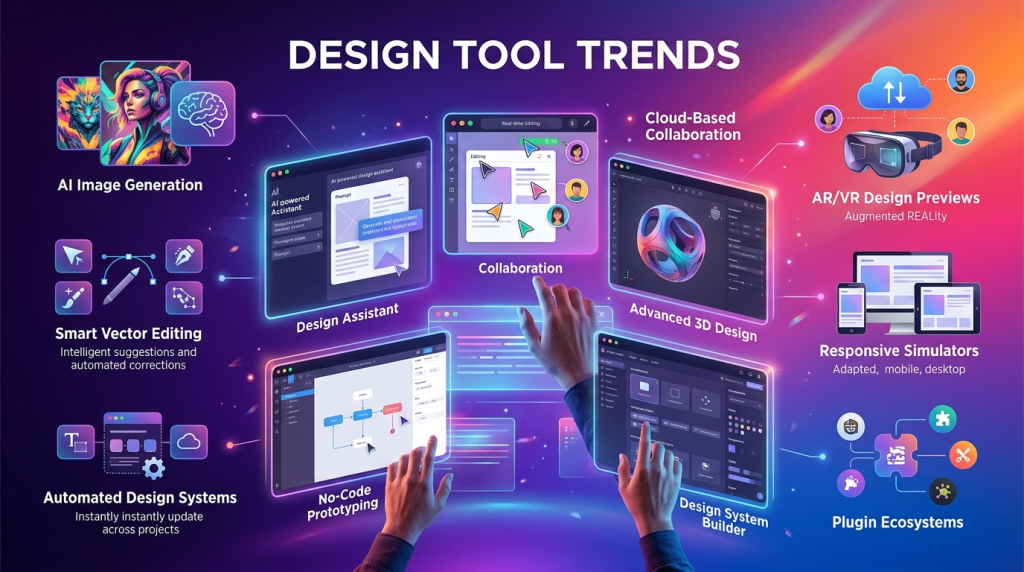
The creative industry evolves quickly. Therefore, understanding current design tool trends is essential for staying competitive. Tools no longer support only visual output. Instead, they shape collaboration, automation, research, and product delivery.
Today, designers must adapt to faster workflows and smarter systems. As a result, modern platforms combine creativity with data, AI, and team integration. Professionals who follow emerging design tool trends gain efficiency and strategic influence.
In this guide, you will discover the most important shifts redefining how designers work in 2026 and beyond.
AI-Powered Design Assistants Are Mainstream
Artificial intelligence has moved from novelty to necessity. Consequently, AI features now appear in nearly every major platform.
Modern systems generate layouts, suggest typography pairings, and automate repetitive tasks. Moreover, AI can resize assets instantly for multiple devices. This saves time and reduces manual errors.
However, automation does not replace creativity. Instead, it enhances ideation. Designers can explore variations quickly and refine strong concepts faster.
Another major shift involves predictive user insights. AI analyzes behavior patterns and suggests improvements. Therefore, teams make smarter design decisions earlier.
Because of these advancements, AI integration ranks among the most influential design tool trends shaping the industry.
Real-Time Collaboration Across Global Teams
Remote work has transformed creative workflows. As a result, cloud-based platforms now dominate the market.
Design files no longer sit on individual desktops. Instead, they live in shared environments. Teams can comment, edit, and prototype simultaneously.
This shift reduces version conflicts. Additionally, stakeholders can provide feedback directly within design files. Faster approvals mean shorter development cycles.
Real-time collaboration also strengthens cross-functional alignment. Designers, developers, and marketers review assets together. Consequently, fewer misunderstandings occur.
Among all design tool trends, collaborative infrastructure continues to redefine how teams operate at scale.
Integrated Design Systems and Component Libraries
Consistency has become a priority. Therefore, organizations invest heavily in structured design systems.
Modern tools now support shared component libraries. Designers reuse buttons, layouts, and UI elements across projects. As a result, brand identity remains consistent.
Furthermore, version control within component libraries prevents outdated elements from reappearing. Teams maintain alignment without manual checks.
These systems also connect directly with development frameworks. Developers access design tokens and spacing rules automatically. This reduces translation errors between design and code.
Because scalability matters more than ever, structured systems remain central in ongoing design tool trends.
No-Code and Low-Code Expansion
Not long ago, developers handled implementation exclusively. However, no-code and low-code platforms now empower designers to build functional prototypes and live interfaces.
These tools allow drag-and-drop logic, interactive animations, and dynamic data binding. Consequently, designers validate concepts without waiting for engineering cycles.
This trend improves testing speed. For example, teams can launch landing pages or micro-experiments rapidly. Immediate feedback supports faster iteration.
Although developers remain essential, designers now influence production more directly. This shift shortens the idea-to-market timeline.
As no-code capabilities grow stronger, they continue to rank high among transformative design tool trends.
Advanced Prototyping and Micro-Interactions
Static mockups no longer satisfy user expectations. Therefore, interactive prototypes now play a larger role in product validation.
Modern platforms allow complex transitions, gesture simulations, and state-based animations. Designers demonstrate real user flows before development begins.
These capabilities reduce ambiguity. Stakeholders visualize experiences more clearly. Additionally, usability testing becomes more accurate.
Micro-interactions, such as button feedback and hover states, enhance emotional engagement. Consequently, attention to small details improves user satisfaction.
Advanced prototyping stands out within current design tool trends because it bridges concept and reality effectively.
Data-Driven UX Decision Making
Design once relied heavily on intuition. While creativity remains vital, data now shapes direction more than ever.
Many tools integrate analytics directly into the design process. Heatmaps, click tracking, and A/B results inform iteration decisions. Therefore, teams avoid subjective debates.
Moreover, user behavior data helps prioritize improvements. Designers focus on friction points that impact conversion and retention.
Because of this integration, design conversations shift from preference to performance. Strategic discussions gain clarity.
Among evolving design tool trends, the integration of analytics into creative platforms signals a major maturity shift.
Cross-Platform and Multi-Device Optimization
Users interact across phones, tablets, desktops, and wearables. Consequently, tools now offer adaptive layout systems.
Responsive grids automatically adjust components for different screens. Designers preview variations instantly. This reduces manual resizing.
Additionally, variable-based styling simplifies updates across breakpoints. A single change can update multiple device views.
Cross-platform consistency strengthens brand trust. Therefore, flexible design capabilities remain central in modern design tool trends.
Accessibility-First Design Features
Accessibility is no longer optional. Instead, inclusive design has become a standard requirement.
Many platforms now include built-in accessibility checkers. Designers receive alerts for low color contrast or improper heading structures. This prevents compliance issues later.
Moreover, tools simulate screen reader behavior. Designers test navigation without specialized software.
By embedding accessibility features directly into workflows, platforms encourage responsible design. As regulations expand globally, this focus continues to shape major design tool trends.
Automation of Repetitive Tasks
Efficiency drives productivity. Therefore, automation tools now handle tasks such as file organization, asset export, and naming conventions.
Designers create custom workflows using plugins or built-in automation scripts. Consequently, time spent on manual processes decreases.
Batch editing capabilities also simplify large updates. Teams modify hundreds of assets simultaneously.
This automation frees creative energy for strategic thinking. Instead of managing files, designers concentrate on problem solving.
Because workflow optimization remains critical, automation stays prominent within current design tool trends.
Integration with Development Pipelines
Collaboration between design and development continues to strengthen. Therefore, integration features grow more sophisticated.
Modern platforms export CSS, design tokens, and spacing variables automatically. Developers access accurate implementation details instantly.
Furthermore, shared documentation links connect prototypes with engineering tickets. This alignment reduces ambiguity.
As product cycles accelerate, seamless integration becomes essential. Among practical design tool trends, tighter engineering collaboration delivers measurable efficiency gains.
Immersive and 3D Design Capabilities
Digital experiences now extend beyond flat interfaces. Therefore, immersive and 3D capabilities gain traction.
Many platforms support spatial design, augmented reality previews, and interactive 3D models. Designers explore depth, lighting, and perspective within standard workflows.
This expansion influences e-commerce, gaming, and education. Additionally, brands use immersive visuals to create memorable experiences.
Although still emerging, immersive design tools represent forward-looking design tool trends that will shape future digital environments.
Subscription Models and Ecosystem Bundles
Business models influence tool adoption. Many providers now offer ecosystem bundles that include design, prototyping, collaboration, and analytics in one subscription.
This consolidation simplifies procurement decisions. Teams access integrated features without juggling multiple vendors.
However, cost management becomes important. Organizations must evaluate which capabilities truly add value.
The shift toward ecosystem platforms signals structural evolution within design tool trends.
Continuous Learning and Skill Adaptation
Tools evolve rapidly. Therefore, designers must commit to continuous learning.
Online communities, template libraries, and plugin marketplaces expand daily. Designers experiment with new features frequently.
Additionally, micro-learning resources help teams stay updated. Short tutorials support quick adaptation.
Because technology changes quickly, adaptability remains essential for long-term success within ongoing design tool trends.
Strong Conclusion
Creative industries move at high speed. Consequently, designers must stay aware of emerging shifts that affect workflow, collaboration, and innovation.
From AI automation to immersive design, the latest design tool trends reflect a deeper transformation. Tools now combine creativity, analytics, and engineering alignment. As a result, design becomes more strategic and measurable.
Those who embrace these changes gain efficiency and influence. Meanwhile, those who ignore them risk falling behind.
Understanding design tool trends does more than improve technical skills. It strengthens decision-making, increases team collaboration, and enhances product quality. By staying informed and adaptable, designers position themselves for long-term growth in a competitive digital landscape.
FAQ
- Why are AI features becoming essential in modern design tools?
AI speeds up repetitive tasks and offers intelligent suggestions. As a result, designers focus more on creativity and strategy. - How do collaborative platforms improve workflow efficiency?
Shared environments reduce version conflicts and allow instant feedback, which accelerates project timelines. - Are no-code platforms replacing developers?
No. They empower designers to prototype faster, but developers still handle complex systems and scalability. - Why is accessibility integrated directly into tools now?
Inclusive design is a standard requirement. Built-in checks help prevent compliance issues early. - How can designers keep up with new software advancements?
Continuous learning, experimentation, and community engagement help professionals stay competitive.